Why does giving out free needles reduce harm? What Taiwan's data say
Free needles are the part of Taiwan's harm reduction programme that raises the most questions. If the goal is to reduce the harm drugs cause, why hand out the tools for injecting them? To understand the policy, it helps to separate two tasks: helping a person cut down or stop using drugs, and lowering the risk of infection and other harm while they are still using. The two can go on at the same time.
Why did Taiwan start giving out free needles?
Taiwan's harm reduction programme grew out of a specific epidemic. In 2004 and 2005, HIV spread quickly among people who inject drugs. In 2005, 3,378 new HIV infections were reported nationwide, and 2,425 of them, about 72%, were in people who inject drugs. Shared needles and shared diluent were the transmission routes that prevention work had to deal with.
In July and August 2005, Taiwan began piloting harm reduction, and clean needles were formally handed out from November that year. In February 2006, Taoyuan Psychiatric Center took in the first patients for methadone substitution treatment, and the services expanded nationwide during 2006. The programme combined needle services, addiction treatment, health education and testing, and linked them to existing HIV care.
How do free needles reduce harm?
A needle programme deals with the risk of infection during injection. Needles, syringes or other equipment that someone else has used may carry blood containing virus. Providing sterile equipment so that every injection can use new supplies reduces the chance of exposure through sharing. Making it free removes cost as a barrier.
Cities and counties supply needles through pharmacies, health centres, hospitals and clinics, and vending machines, and the machines let people get equipment without returning used needles. In Taipei, the September 2026 list of service points includes 19 vending machines open around the clock, 12 at pharmacies and 7 at Taipei City Hospital, plus 37 health education and counselling stations. Free distribution and vending machines working side by side give people more flexibility in how and when they get needles.
Methadone and clean needles appear together in harm reduction because they deal with different problems. Methadone, taken by mouth, eases withdrawal discomfort and craving in people dependent on heroin and helps them inject less; clean needles lower the risk of infection each time someone does inject. Some people have not yet started treatment, and some still inject while in treatment; both need access to clean equipment.
Needle services have another important role: they give health workers a chance to reach people who rarely enter the health system. Collecting needles and talking with staff builds trust step by step, and from there people can be offered testing, referred to addiction treatment such as methadone, or helped into treatment for HIV and hepatitis. Needle services thus also become a doorway connecting people who use drugs with health care.
This is also the direction the World Health Organization (WHO) recommends. WHO's 2022 consolidated guidelines list needle and syringe programmes, opioid agonist maintenance treatment, and testing and treatment for HIV and viral hepatitis among the services people who inject drugs need. Reducing stigma, discrimination and the structural barriers that keep people from care is listed as equally important for the services to work.
What do Taiwan's data say?
The long-term reporting data show a clear change. As noted above, 2,425 new HIV diagnoses were reported among people who inject drugs in 2005; in 2021, the official epidemic summary recorded 22, about 2% of all new reports that year. Reported numbers, however, also depend on testing, diagnosis and registration, so they are not the same as the number of new infections that year, and the whole gap between the two years cannot be credited to the needle programme.
Studies of specific groups found a similar improvement. Among people entering prison with a history of injecting drugs, the estimated proportion newly infected with HIV each year fell from about 18% in 2005 to under 1% in 2010. The same study found that people receiving methadone had a lower risk of infection. This Taiwanese study was published in an international journal.
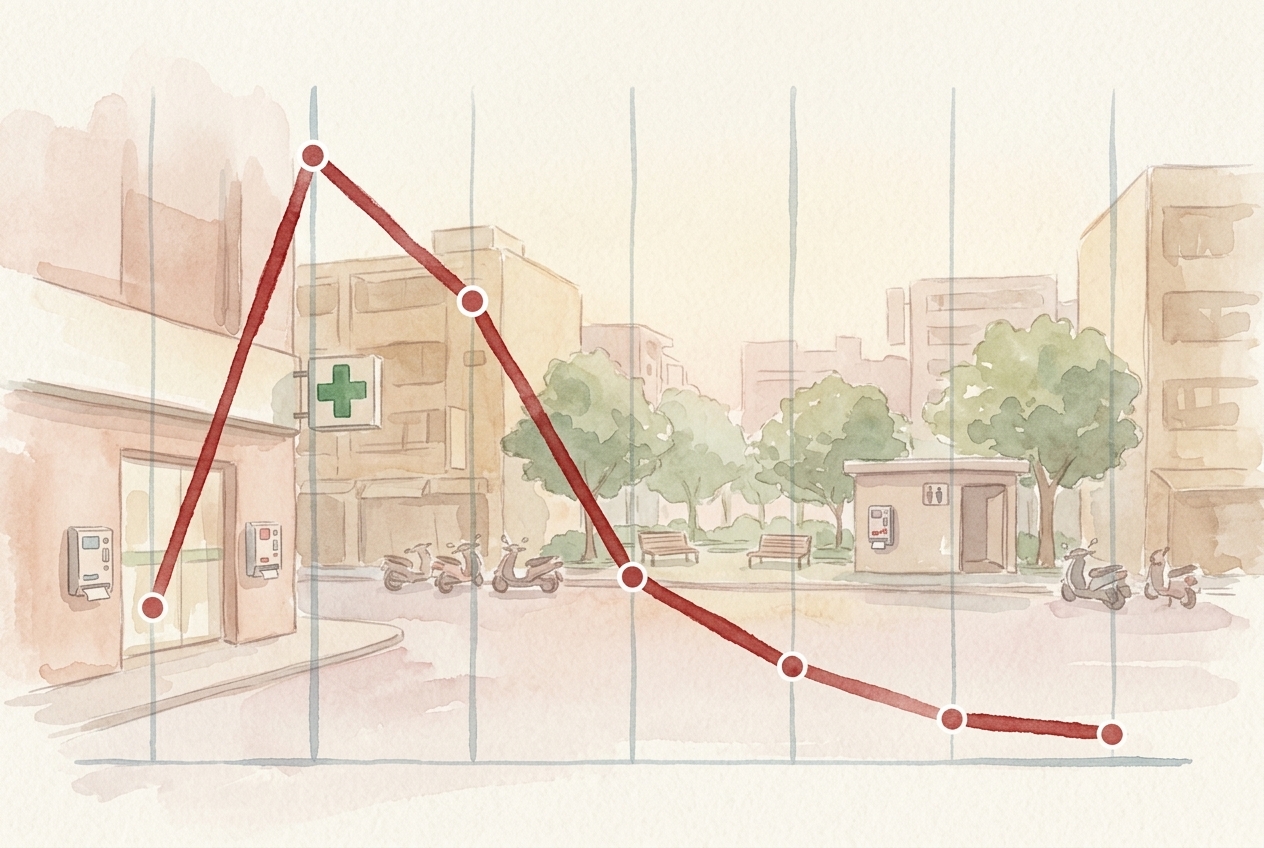
These results support the effectiveness of Taiwan's harm reduction programme. But needle services, methadone, health education, testing and HIV treatment were all running at the same time, so the improvement cannot all be credited to free needles.
Other countries offer useful comparisons. Australia introduced needle programmes in 1986, and in annual surveys of needle programme clients from 1995 to 2024, HIV antibody prevalence has stayed below 2.5%. In China, after methadone and needle services were rolled out, HIV incidence among methadone clients fell from about 1% in 2006 to 0.03% in 2018; this is a result in people receiving treatment and cannot be read as the effect of free needles alone.
The improvement in HIV does not carry over automatically to every infection. At Taipei City Hospital, among 1,447 people who inject drugs who entered methadone treatment and the study between 2006 and 2010, about nine in ten tested positive for hepatitis C antibodies. This reflects infections accumulated in the past, and a high prevalence alone does not show that the programme failed; it is also a reminder that many people with infections still need diagnosis and care.
Preventing hepatitis C also means paying attention to how drugs are prepared. Even with a new needle, shared diluent, containers or filters contaminated with infected blood can still spread infection. So besides clean needles, people need a full set of hygiene supplies and guidance on use, and help getting treated if infected.
Does giving out needles increase drug use?
A Taiwanese study found no sign that heroin use rose after harm reduction began. Researchers analysed data on people caught using drugs for the first time from 2001 to 2017 and found that after the programme started in 2006, the first-offence rate for heroin fell further, mainly among people under 40; methamphetamine and ecstasy showed no change linked to the start of the policy.
WHO also states that making clean needles easier to get does not increase drug use. Whether the number of people using drugs has fallen, though, cannot be judged from first-offence rates alone, because the number of people caught also changes with policing and with the drug market.
What does a programme need in order to work?
First, needles have to be easy to get, and there have to be enough of them. Locations, opening hours and the rules for collecting needles should all suit the people who use the service, so that every injection can use clean equipment. A California study also found that sites giving out needles according to need met people's needs better than sites that capped supply and required one-for-one exchange.
Second, people need to feel safe asking for help. An early survey in Taoyuan found that fear of police surveillance or arrest made people reluctant to collect or return needles. That is why cooperation from law enforcement, privacy protection and a respectful attitude all matter.
Finally, needle services need to connect people to further care. Besides handing out hygiene supplies, they should use this point of contact to offer counselling, testing and referral to treatment. WHO's operational guide also stresses service integration and steady supply, so that these arrangements keep working over the long term.
Sources
- Ministry of Health and Welfare. Harm reduction programme brings down HIV among people who inject drugs (in Chinese). New reports in 2005.
- Taiwan CDC. Clean needle programme at one year (in Chinese). 31 October 2006.
- Taiwan CDC. Taoyuan Psychiatric Center expands substitution treatment (in Chinese). 2 May 2006.
- Taiwan CDC. Does methadone make you slow? Correcting a rumour (in Chinese). 19 July 2007.
- Ministry of Health and Welfare. HIV/AIDS epidemic summary, 2021 (in Chinese), p. 3.
- Taipei Open Data. Taipei clean needle service points (in Chinese). Version of 3 September 2026.
- Chen CL. First year of the clean needle programme in Taoyuan (in Chinese). Taiwan Epidemiol Bull. 2008;24(2).
- Hsu SY, et al. HIV risk behaviours among people who inject drugs (in Chinese). Taiwan Epidemiol Bull. 2007;23(10):549-560.
- Huang YF, et al. Changes in HIV incidence among people who inject drugs in Taiwan following introduction of a harm reduction program: a study of two cohorts. PLoS Med. 2014;11:e1001625.
- Yen YF, et al. Prevalences and associated risk factors of HCV/HIV co-infection and HCV mono-infection among injecting drug users in a methadone maintenance treatment program in Taipei, Taiwan. BMC Public Health. 2012;12:1066.
- Chen WJ, et al. The impact of Taiwan's implementation of a nationwide harm reduction program in 2006 on the use of various illicit drugs. Harm Reduct J. 2021;18:117.
- Van den Berg C, et al. Full participation in harm reduction programmes is associated with decreased risk for human immunodeficiency virus and hepatitis C virus: evidence from the Amsterdam Cohort Studies among drug users. Addiction. 2007;102:1454-62.
- Hagan H, et al. Sharing of drug preparation equipment as a risk factor for hepatitis C. Am J Public Health. 2001;91:42-46.
- Bluthenthal RN, et al. Examination of the association between syringe exchange program (SEP) dispensation policy and SEP client-level syringe coverage among injection drug users. Addiction. 2007;102:638-46.
- Wu ZY, Scott SR. Human immunodeficiency virus prevention strategies in China. Chin Med J. 2020;133:318-25.
- World Health Organization. Needle and syringe programmes for people who inject drugs: operational guide. 2025 (PDF, p. 8)
- World Health Organization. People who inject drugs (recommended package from the 2022 consolidated guidelines).
- Parliament of Australia, House of Representatives. Needle and syringe programs (committee report, chapter 4).
- Kirby Institute, UNSW. Australian NSP Survey 30 year National Data Report 1995–2024. 2025.