If Taipei has always voted KMT, how did Kao Yu-shu win?
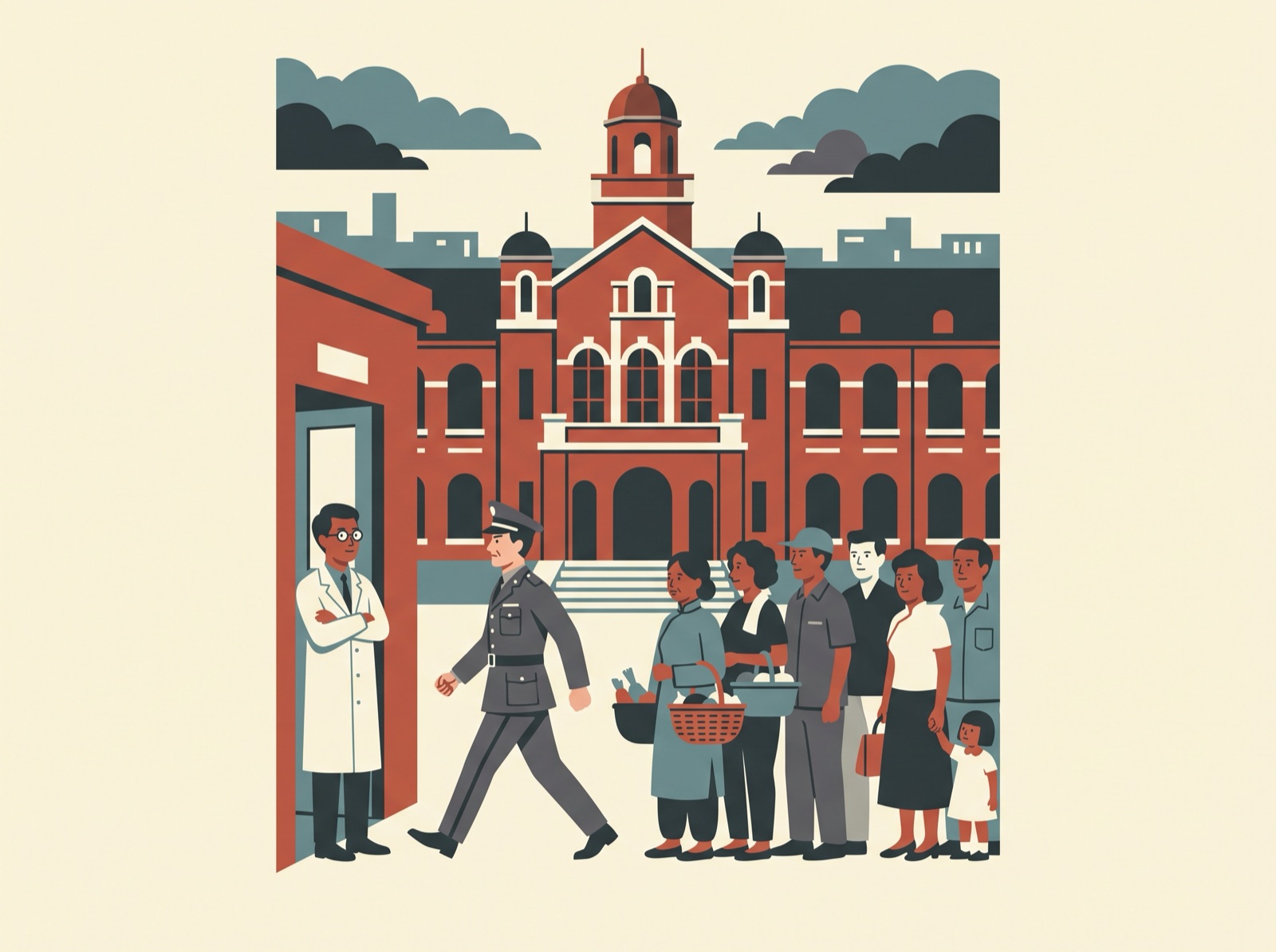
Not long after the end of World War II, a man in military uniform walked into the ophthalmology department at National Taiwan University Hospital.
His name was Wang Min-ning. At the time, he headed the adjutant office of the Taiwan Garrison Command. He had conjunctivitis and had come to the hospital for treatment.
The problem was that he did not want to wait.
According to a later recollection by Tu Tsung-ming, the first dean of the NTU College of Medicine, Wang demanded to be seen ahead of other patients. The physician on duty, surnamed Lin, refused.
Wang insisted. An argument followed.
Seeing Wang in uniform, Lin assumed he was a Mainlander who had arrived after 1945 and did not understand Japanese. In front of a Japanese professor, Lin began insulting him in Japanese.
The dispute eventually reached Tu Tsung-ming.
Wang complained that Lin had been disrespectful. Lin did not back down. Instead, he replied with an even cruder insult:
"My chinpo is bigger than yours."
What happened next was no joke.
Lin was taken to the Garrison Command and detained for several days.
A few years later, Taipei voters were reminded of the episode.
In 1954, Wang Min-ning became the Kuomintang's candidate for mayor of Taipei.
His opponent was Kao Yu-shu.
The Kuomintang did not have an easy time winning Taipei
Looking back from the present, it is easy to imagine Taipei as a city that was always naturally favorable to the Kuomintang.
It was not.
Between 1951 and 1964, Taipei held five direct mayoral elections while it was still a provincial city. Independent candidate Wu San-lien won the first. Independent Kao Yu-shu won the second. The Kuomintang's Huang Chi-jui won the third and fourth. Then Kao returned and won the fifth.
In other words, the KMT's official candidate won only two of those five elections.
The capital was not nearly as easy for the ruling party to dominate as later political maps might suggest.
The 1954 election was especially painful.
Wang Min-ning was a military-bureaucratic figure who had trained at the Imperial Japanese Army Academy and later became head of the Taiwan Provincial Police after the February 28 Incident.
He embodied a very recognizable form of postwar state power.
But much of Taipei's population still lived in older districts such as Dadaocheng, Bangka, and Daqiaotou, where merchants, street vendors, workers, and dense neighborhood networks remained socially powerful.
For many residents, the Kuomintang was not an abstract political party.
It was the police. It was the bureaucracy. It was official regulation and enforcement.
And it was the man who could walk into a hospital and expect everyone else to move aside.
That is why the old hospital story mattered politically. When it resurfaced during the campaign, it spoke to a broader social question:
Who had power, and who was expected to give way?
Kao Yu-shu campaigned in a very different style.
Without a powerful party machine behind him, he went into local society. He visited markets, met neighborhood figures, and built support through networks in Dadaocheng and Bangka.
He later described the strategy simply as "grass roots."
And then the election began to slip away from the KMT.
Even firecrackers became political
As Wang Min-ning's campaign ran into trouble, what should have been a local election began drawing the attention of the central government.
According to the recollections of Li Shih-chieh, who had worked in the Investigation Bureau, Chiang Ching-kuo, then serving in the Presidential Office's intelligence apparatus, summoned security and intelligence chiefs to discuss how to rescue Wang's campaign.
The Investigation Bureau formed a special task force. Taipei police were instructed to pay attention to the campaign atmosphere on the streets.
Even firecrackers became political.
When Kao Yu-shu's motorcade passed through a neighborhood, shopkeepers were discouraged from setting them off. When Wang Min-ning's procession came through, residents were encouraged to do the opposite.
Another tactic was rumor.
Kao had studied in the United States and had American contacts, so a story began circulating:
Kao Yu-shu was a CIA agent.
Presumably, the point was to make him sound like a foreign spy.
Instead, the rumor backfired.
In the shadow of the February 28 Incident and authoritarian rule, some Taiwanese hoped the United States might restrain the Kuomintang government or push it toward political liberalization.
To them, the suggestion that "Kao has Americans behind him" did not necessarily sound threatening.
It could sound reassuring.
If Kao really had ties to the CIA, some reasoned, perhaps the KMT would think twice before moving against him.
A rumor meant to discredit Kao instead added to his mystique.
There was also a more direct form of resistance.
Kang Ning-hsiang later recalled that some voters would happily go to Wang Min-ning's campaign headquarters, eat the food provided there, walk out with campaign literature, and then bring the material over to Kao's camp to be burned.
Their slogan was simple:
"Eat Wang Min-ning's food. Vote for Kao Yu-shu."
On May 2, 1954, the votes were counted.
Kao Yu-shu received 110,415 votes.
Wang Min-ning received 97,613.
An independent candidate with no KMT party machine behind him won 53.08 percent of the vote and defeated the ruling party's fully backed candidate.
But the story did not end there.
According to Kang Ning-hsiang's later account of what U.S. Military Assistance Advisory Group chief William C. Chase told him, the vote tally stopped updating after about 10 p.m.
Chase believed that, based on the figures already available, Kao had clearly won. He reported the situation to the U.S. State Department, after which Washington sent a congratulatory message.
The American role here should not be reduced to "the United States helped Kao win."
A more accurate way to put it is that the American military and diplomatic presence in Taiwan created an additional layer of scrutiny around the result.
Taiwan was still under martial law. American advisers did not run Taiwanese elections, and Washington was not about to supervise local vote counting.
But the United States cared about political stability, local self-government, and the legitimacy of an anti-Communist ally that depended heavily on American aid and security support.
For the Kuomintang, an election widely seen as openly falsified could damage not only its domestic credibility but also its standing with Washington.
So when Chase reported the vote count and Washington sent congratulations, the message may have carried more weight than ordinary diplomatic etiquette.
The implied signal was clear enough:
The count could be delayed, but the result could not simply be rewritten.
Kao later believed that the American message played an important role in securing recognition of his victory.
Chiang Kai-shek ultimately ruled that the election result was valid.
And so something remarkable happened.
In the capital of a country under martial law, a man without a ruling-party membership card defeated the Kuomintang's candidate at the ballot box and became mayor of Taipei.
The United States was not the referee of Taiwan's political system. But in this case, it functioned as a kind of external guardrail: it could not stop every form of administrative interference, but it made it harder for the ruling party simply to ignore the result.
Three years later, he lost
Kao soon learned that winning once did not mean the rules of the game had become fair.
In 1957, he ran for re-election against the Kuomintang's Huang Chi-jui.
This time, he lost.
According to the official result, Huang received 176,238 votes, while Kao received 121,508.
The election, however, remained controversial. The most famous allegation involved power outages during the count.
In 1960, Kao initially registered to run again but later withdrew.
According to Kao's own account, one important reason was that he asked whether candidates would be allowed to appoint their own vote monitors and was told no. Without effective monitoring, he believed there was no realistic way to prevent fraud.
Other accounts suggest personal reasons also contributed to his withdrawal.
The point is important: American pressure did not mean Taiwan had suddenly acquired a fair electoral system.
Outside scrutiny could raise the political cost of rewriting a result at a crucial moment. It could not replace transparent counting, independent monitoring, or equal competition inside polling stations.
So when Kao ran again in 1964, he tried something different.
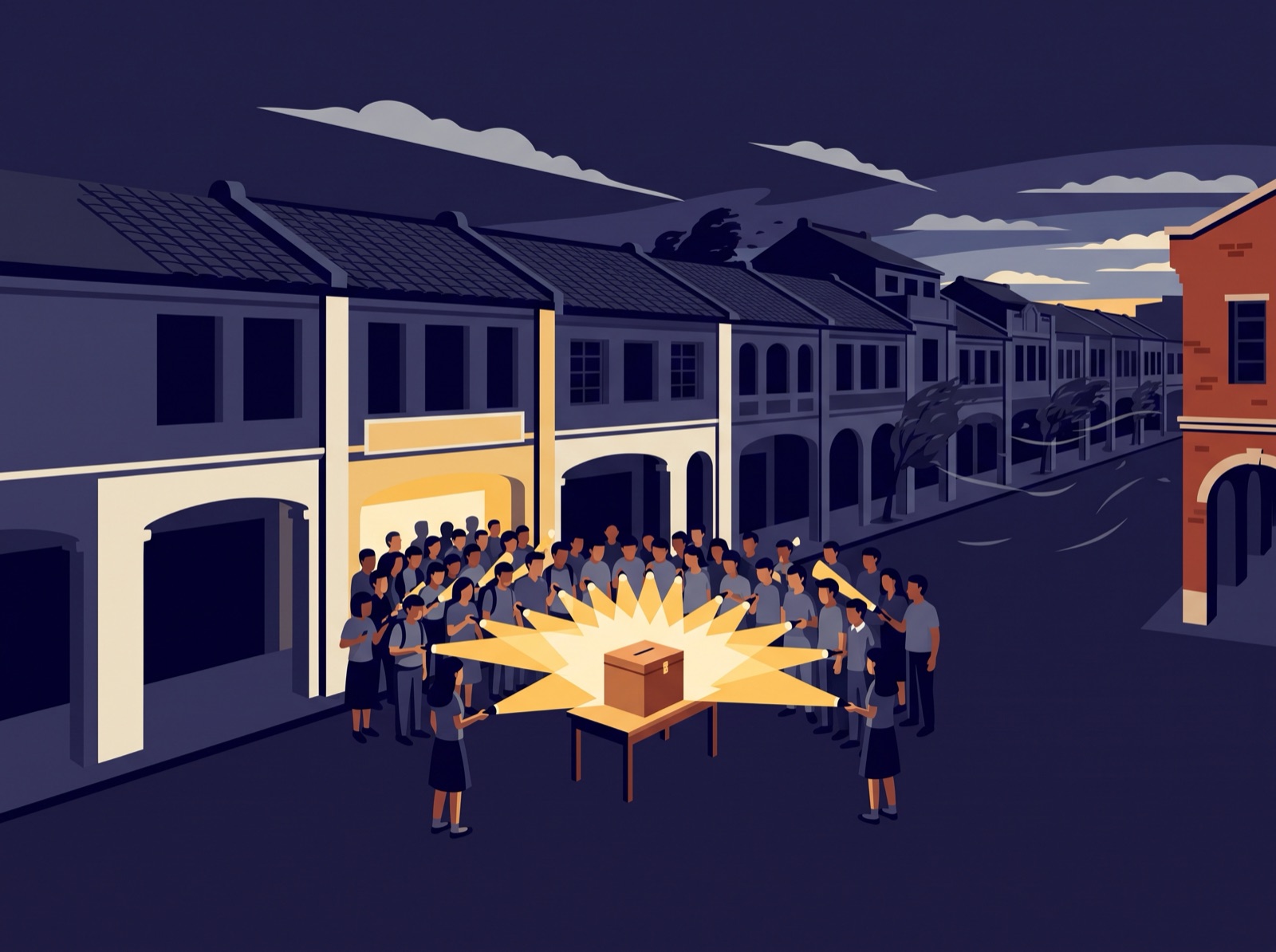
If the lights might go out, he would bring his own.
A thousand flashlights
In the 1964 Taipei mayoral election, Kao Yu-shu faced the Kuomintang's Chou Pai-lien.
To secure enough legal monitoring slots, Kao's camp even arranged for his friend Li Chien-sheng to register as another candidate, increasing the number of monitors they could deploy.
More important were the students.
Chang Ming-chang, then a student at National Chung Hsing University's College of Law and Business, helped recruit university students from NTU, Chung Hsing, Tamkang, and other schools to monitor polling stations across the city.
Each was given a flashlight.
Four batteries.
The reason was almost absurdly simple:
If the power went out again, keep watching the ballot box.
On April 26, 1964, Kao Yu-shu received 191,838 votes.
Chou Pai-lien received 176,117.
Kao won again.
The margin was only about fifteen thousand votes.
One side had the ruling party, the administrative apparatus, the police, and the intelligence services.
The other side had students standing beside ballot boxes with flashlights.
The people with the flashlights won.
This time, external pressure still mattered, but the people actually protecting the ballots were not American military advisers or officials in Washington.
They were the monitors who stayed in the polling stations and kept watching.
Then Taipei stopped electing its mayor
Three years later, in July 1967, Taipei was elevated to a centrally administered municipality.
Its mayor was no longer directly elected.
The position became centrally appointed.
Kao Yu-shu became the last elected mayor of provincial-city Taipei and was retained as the first appointed mayor of the new municipality.
Taipei residents would not directly elect a mayor again until 1994.
Twenty-seven years had passed.
If we look only at Taipei politics from the 1990s onward, it is easy to imagine the city as a natural Kuomintang stronghold.
Kao Yu-shu's story reminds us that it was not.
What changed was not only party politics.
The city itself changed.
After the central government relocated to Taiwan in 1949, large numbers of soldiers, civil servants, teachers, and their families moved into Taipei.
Central government institutions were concentrated in the capital. Japanese-era official residences were reassigned. The military built dependent settlements across the city.
These newcomers were not evenly distributed.
Areas such as Da'an and Guting gradually accumulated large numbers of military, civil-service, educational, and central-government households.
Older commercial districts such as Dadaocheng, Bangka, and Daqiaotou, by contrast, retained denser local commercial and social networks.
Taipei gradually developed a distinctive political geography:
Old city and new city. West and east. Local commercial society and the military-civil-service state.
They occupied the same city but often lived through very different historical experiences.
Housing policy reinforced those differences.
Military dependent villages, civil-service housing, and later public housing enabled many state-linked families to remain concentrated in particular communities over long periods of time.
Work, housing, welfare, schooling, and political organization frequently overlapped.
These housing patterns were not created all at once. They accumulated from the 1950s through the 1980s.
After 1949, the government and military used Japanese-era official residences, barracks, and public land to house soldiers, civil servants, and their dependents, while also building new settlements.
The 44 South Village, which had already begun forming in 1948, housed workers and families attached to the 44th Arsenal. Chia-ho New Village was established in 1956. Central New Village in Beitou grew gradually after the war around facilities connected to a former Japanese military hospital.
Over time, these places became more than "where soldiers lived."
They developed welfare systems, schools, neighborhood organizations, and dense social networks. Housing, employment, and everyday life became closely tied to military and state institutions.
The migrants who arrived around 1949 were no longer temporary newcomers.
They were becoming permanent Taipei residents.
By the 1960s, Taipei's housing problem had expanded beyond military dependents to the pressures of rapid urbanization more broadly.
On November 29, 1964, the first phase of South Airport Public Housing was completed. Large apartment-style projects were becoming an increasingly important tool of urban policy.
Taipei's population was also growing at extraordinary speed: it passed one million in 1965 and exceeded two million by 1975.
Then the city itself expanded.
On July 1, 1968, Jingmei, Muzha, Nangang, and Neihu were incorporated from Taipei County, while Shilin and Beitou were incorporated from the Yangmingshan Administrative Bureau.
This matters enormously for understanding Taipei politics.
The "Taipei" in which Kao Yu-shu campaigned in the 1950s was not the same electorate as the Taipei we know today.
At the time, older districts such as Dadaocheng and Bangka still accounted for a much larger share of the city's population and political life.
After 1968, Taipei expanded dramatically eastward, southward, and northward. Large populations that had previously lived outside the city suddenly became Taipei residents and, eventually, Taipei voters.
Housing development continued to reshape the city.
The Xinglong public housing complex, completed in 1973, was one example of the expansion of public housing. Land acquisition for the Wanfang area began in 1978, with most development taking place in the 1980s.
Meanwhile, older military settlements were themselves transformed.
The Chenggong New Village complex, originally established in 1951, was eventually redeveloped into large apartment blocks, and the Chenggong Public Housing complex was completed in 1985.
Taipei was also dotted with postal-service housing, civil-service housing, and residential compounds belonging to different branches of the military and central government agencies.
They varied in size and origin, but collectively they housed large numbers of people whose livelihoods were closely connected to the central government, the armed forces, and the civil service.
So postwar Taipei did not simply "build a lot of military villages."
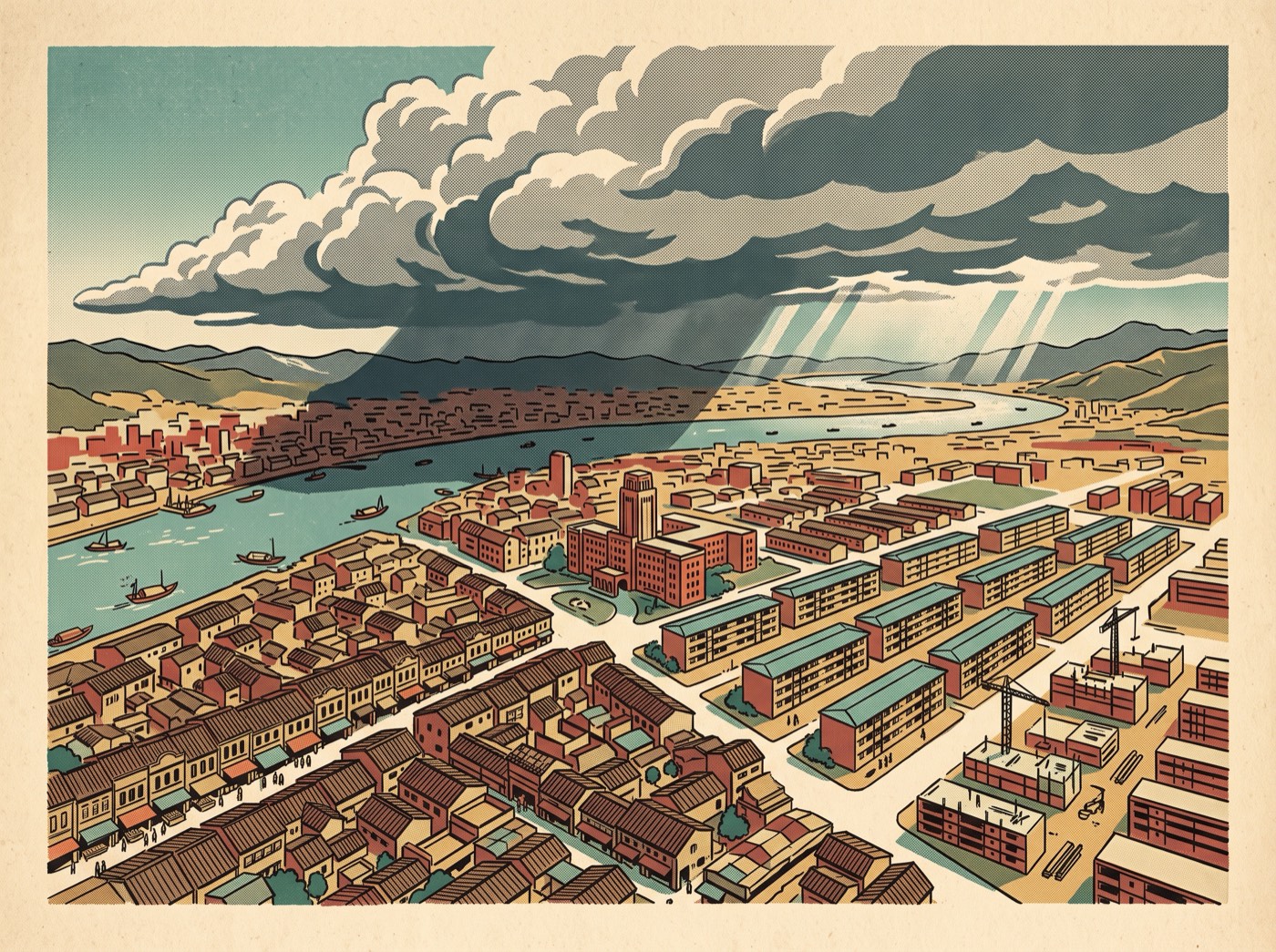
Over several decades, military resettlement, civil-service housing, public housing, administrative expansion, and new urban development changed where people lived and who lived where.
By the time Taipei regained the right to elect its mayor in 1994, it was no longer the city Kao Yu-shu had campaigned through forty years earlier. Its boundaries had changed. Its neighborhoods had changed. The people who called themselves Taipei residents had changed.
And yet something had survived those decades too.
The stubborn belief that a vote, once cast, ought to count.
That belief was still fragile in Kao's time. It had to be defended in strange and improvised ways: through neighborhood networks, by people willing to take the ruling party's food and vote against it anyway, and by students standing beside ballot boxes with four-battery flashlights in their hands.
They could not have known what Taiwan would become.
They did not know that martial law would one day end. They did not know that opposition parties would become legal, that presidents would be chosen by popular vote, or that power would pass peacefully between parties.
They were simply trying to make one election mean what an election was supposed to mean.
That is perhaps what makes Kao Yu-shu's Taipei feel less like a vanished city and more like an early glimpse of the Taiwan that was still to come.
Democracy did not arrive all at once. It accumulated slowly through imperfect elections, contested rules, ballots that people insisted on watching, and the ordinary stubbornness of citizens who refused to believe that power should always have the final word.
The political map of Taipei would change again and again.
So would Taiwan.
But perhaps the most important thing those students carried into the polling stations in 1964 was not the flashlight itself.
It was the conviction that when the lights went out, someone should stay and keep watching.
Sources
- Tu Tsung-ming, Memoirs (回憶錄), vol. 2 (Taipei: Longwen, 1998), p. 187. (The hospital episode.)
- Lin Chung-sheng (ed.), The Memoirs of Kao Yu-shu (高玉樹回憶錄:玉樹臨風步步高) (Taipei: Avanguard, 2007). ("Grass roots", the 1960 withdrawal, the 1964 monitors.)
- Kang Ning-hsiang, Taiwan, Fighting On: The Memoirs of Kang Ning-hsiang (台灣,打拼:康寧祥回憶錄) (Taipei: Asian Culture, 2014). (The Chase message; "Eat Wang Min-ning's food.")
- Li Shih-chieh, Secret Agents Fight an Election (特務打選戰) (Taipei: Dunli, 1989). (Chiang Ching-kuo's meeting, the firecrackers, the CIA rumor.)
- Huang Chen-chao, Taipei City Gazetteer, vol. 3, Political System: Elections (臺北市志・卷三・政制志選舉篇) (Taipei City Documents Committee, 1987). (Vote counts for the three elections.)
- Chou Wan-yao, "Flashlights and Piano Playing: A Glimpse of the KMT's History of Vote Rigging" (手電筒與彈鋼琴), Tell Taiwan.
- Hsueh Hua-yuan, "Taipei becomes a centrally administered municipality", Chronology of Postwar Taiwan History, Academia Sinica.
- National 228 Memorial Museum online exhibition, "Be the Master, Cast a Vote: A History of Taipei Mayoral Elections".
- Office of the President, "Presidential citation for Kao Yu-shu", 4 July 2005.
- Taiwan Cultural Memory Bank: History of the South Airport public housing, Chenggong public housing, Taipei about to become a municipality (Academia Historica).